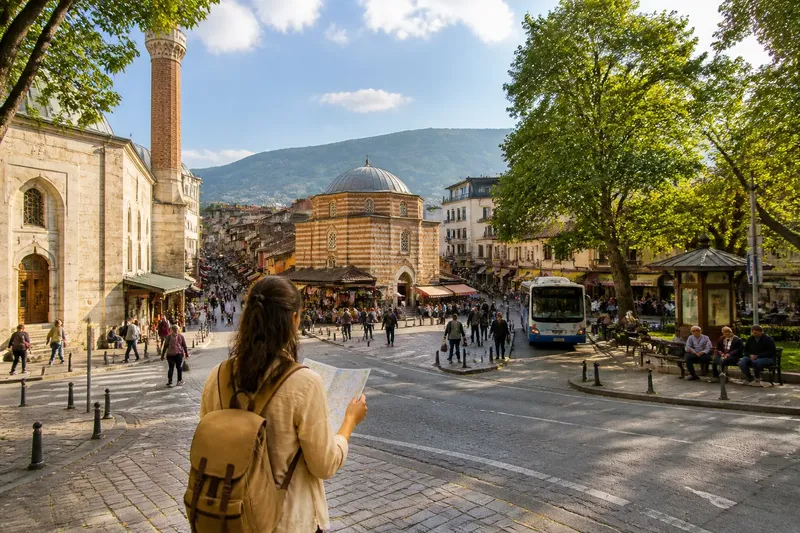
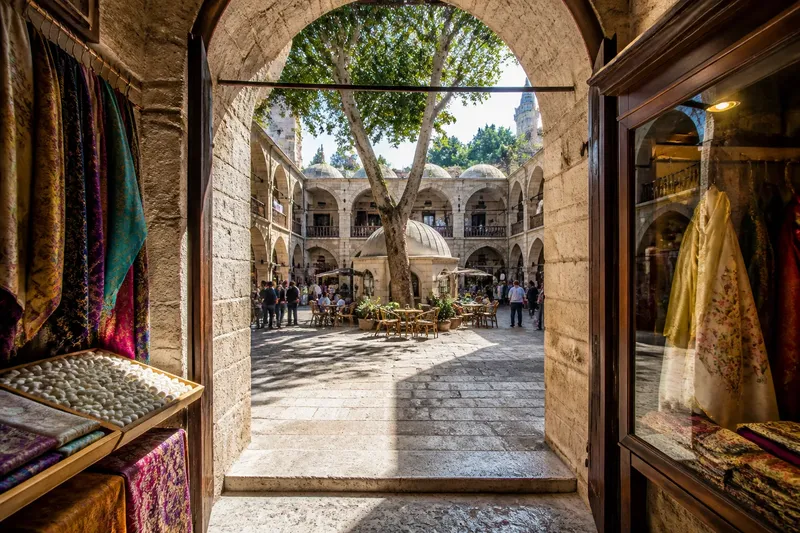
A Mosque Courtyard or a Covered Passage? Two Different Ways to Pause in Bursa
Choose a mosque courtyard or covered passage in Bursa for a pause that fits the setting, keeps routes clear, and helps you find your next landmark.
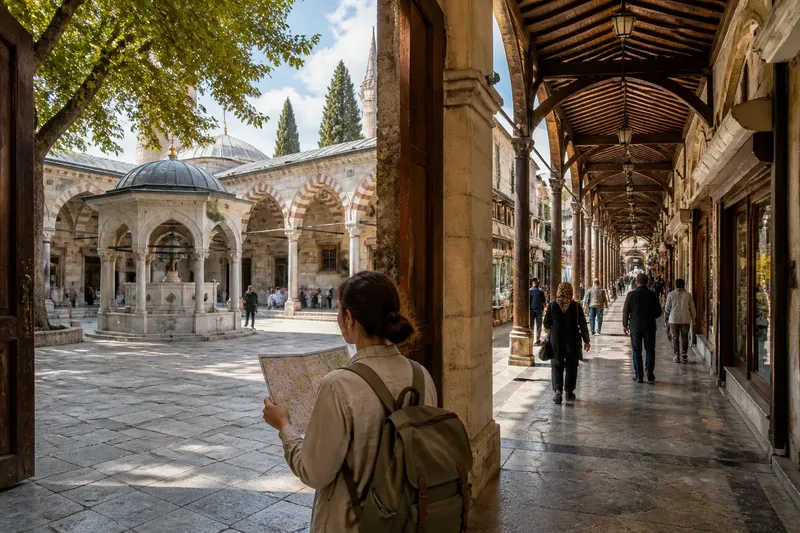
The common mistake is treating a mosque courtyard and a covered passage as interchangeable places to stop; the cost is a pause that may interrupt worship or block a working route. In Bursa, the choice is clearer if you ask whether you need a quiet moment to read a mosque’s setting or shelter while moving through the city.
How do mosque courtyards and covered passages differ?
A mosque courtyard belongs to a religious complex, where people may be arriving to pray, meeting others, or carrying out routine tasks. A covered passage is a route between or through buildings; shopfronts and doorways may face it, but people still need to move along it.
In Bursa, that difference is especially useful around historic districts, where a short walk can shift from a mosque precinct to a commercial street or covered route. The exact layout varies by site, so notice the entrances, signs, and current activity rather than assuming every courtyard or passage works the same way.
A courtyard is like a room with the sky for a ceiling; a passage is more like a hallway. The first may give you a moment to take in a setting, while the second helps you continue through it.
Which space suits the pause you need?
Choose a courtyard if it is open to visitors and offers a place to stop without disturbing people or blocking an entrance. Choose a covered passage for a brief direction check or a sheltered stretch of your route, provided you can stand aside from the walking line.
Imagine you have reached a mosque courtyard after walking through central Bursa, and your map shows two possible streets ahead. You notice that the entrance is busy and there is no clear place to sit, so you check the signs from the edge, identify the street exit, and leave rather than lingering; the result is a route decision without obstructing people. If the passage on your way onward is also crowded, continue to a wider public spot before checking the map again.
How can these places help you find your way?
A courtyard’s boundaries can help you orient yourself. Note the entrance you used, the main doorway, and the street visible beyond the exit. In the dense streets around Bursa’s historic core, those relationships can be easier to remember than a sequence of unfamiliar street names.
A passage offers a different kind of clue: sequence. Remember a turn, a shopfront, a change in paving, or the point where the roof ends. Look back to confirm where you came from, then check where the route opens. Passages can have several exits, so verify your next landmark on a map when you can stop without blocking anyone.
What details are worth noticing?
In a courtyard, notice how entrances, walls, and open space relate, and how the sound changes between the street and the mosque precinct. In a passage, look for the rhythm of doors, columns, roof supports, or shopfronts where present. These details vary across Bursa; let the particular place guide your attention rather than expecting a standard design.
Keep your attention on the architecture and public movement. Avoid photographing people without permission, and do not enter a shop, doorway, or other private area just to inspect a detail. Leave working entrances and narrow sections clear.
How should you behave in a mosque courtyard?
Treat the courtyard as part of an active religious setting. Follow posted guidance, move quietly, and leave access to the mosque clear. If a prayer or community activity is underway, give people space and postpone your pause.
Access and dress expectations can differ from one site to another. If signs do not answer whether visitors may enter, ask someone responsible for the site. Do not assume that an open doorway means every area beyond it is open to visitors.
For photographs, focus on the building and avoid interrupting worship or including people without permission. A visitor’s interest in a courtyard should remain secondary to the place’s everyday use.
What do visitors ask about mosque courtyards and covered passages?
Can visitors sit in a mosque courtyard?
Only if the site is open to visitors and there is an appropriate place to sit without interfering with worship or access. If the courtyard is busy or has no suitable seating, keep moving or choose another public resting place.
Can I stop in a covered passage to check a map?
Yes, if you can stand to one side and keep the walking line clear. If people would need to move around you, continue to a wider spot before checking directions.
Which is better for shelter from rain?
A covered passage may offer shelter while keeping you on your route, depending on its design and openings. A courtyard may be more exposed, so check the conditions and avoid stopping near an entrance.
Are all courtyards and passages open to visitors?
No; access depends on the site, its current use, and posted restrictions. Follow signs and staff guidance, and do not enter through a doorway simply because it is visible.
How can you choose a considerate stopping place?
Before stopping, look at how people are using the space and make a choice based on what you see:
- If people are entering or leaving a mosque, keep the entrance clear; if the flow is steady, move to another open area before pausing.
- If a courtyard has posted visitor guidance, follow it; if signs restrict access or are unclear, ask site staff or stay outside the restricted area.
- If worship or a community activity is underway, postpone your stop; if the activity ends and visitors are permitted, pause quietly at an unobtrusive edge.
- If a passage narrows near a turn or doorway, keep walking; if you need to consult a map, move to a wider section or another suitable public spot.
- If you cannot identify the exit you need, check a map from a place that leaves the route open; if the passage is too busy, continue to a quieter location first.
- If you want a photograph, frame architectural details without including people; if that cannot be done respectfully, put the camera away.
When choosing a mosque courtyard or covered passage in Bursa, match the pause to both the place and its current use. The best clue may be as ordinary as a clear entrance or a route people need to keep using: notice it, adjust your position, and let the city’s daily movement continue around you.