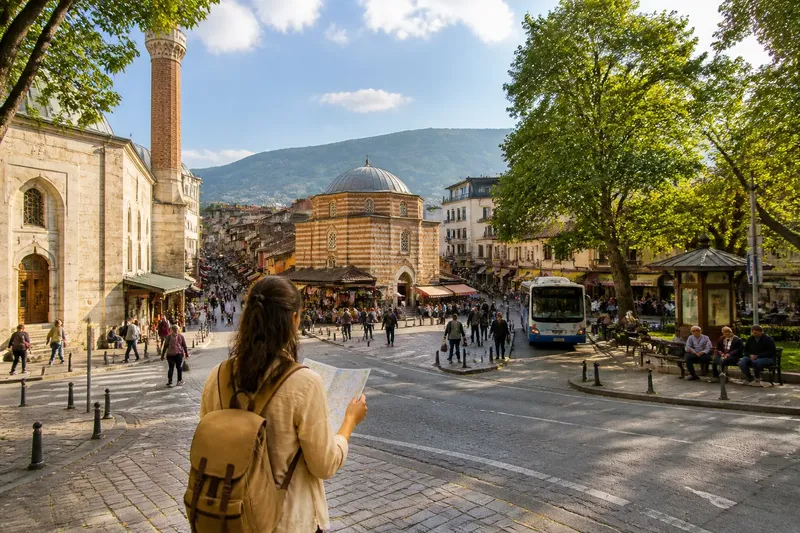
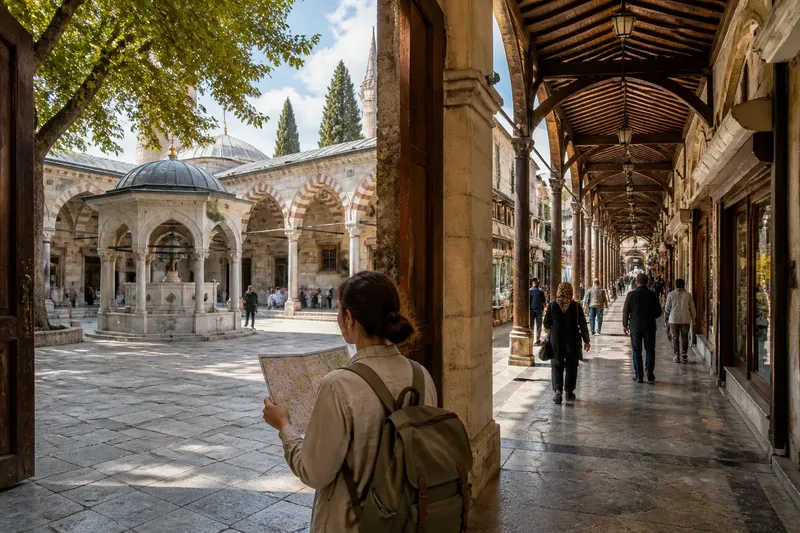
How Koza Han Keeps Bursa’s Silk Trade Visible
Koza Han’s silk trade comes into focus through its courtyard, shopfronts, and place in Bursa’s historic center, helping you read the landmark beyond its displays.
The common mistake at Koza Han is to see a handsome courtyard and a row of shops, then treat them as unrelated attractions. That misses how the building’s commercial identity and its place in Bursa’s historic center meet in the same space. Koza Han’s silk trade is easier to understand by looking at the building’s layout alongside the activity around it.
What can the entrance tell you?
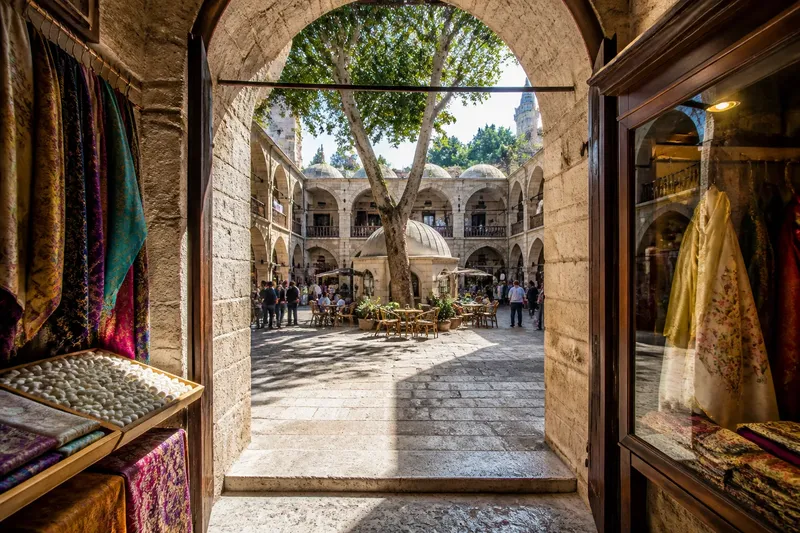
Pause at the entrance before walking into the courtyard. The passage from a commercial street into a more enclosed interior makes a clear change in pace and view: the opening frames the court, while the surrounding lanes remain close at hand. A han is a commercial building associated with traders and business, and Koza Han’s threshold helps you notice how such a place can gather activity without being detached from the city.
After entering, turn back toward the street. The view makes the relationship visible: the building draws you inward, but its entrance still opens onto Bursa’s historic commercial center. That contrast is more specific than simply calling the courtyard peaceful. It shows how an inward-facing plan can belong to a busy district.
How does the courtyard make the plan readable?
Stand where you can see the open center and the shopfronts around it. The court gives the surrounding rooms a shared edge and makes the building’s arrangement easy to grasp without a floor plan. Like a table surrounded by chairs, the center helps you understand how the parts relate, even as each shop has its own entrance and display.
Look from the open court toward the covered edges, then compare the view with the route you took in. The contrast between open center and enclosed rooms is part of the building’s practical character: visitors can orient themselves in the court while businesses occupy the spaces around it. Notice how doors, signs, and goods now shape the edges, rather than assuming every visible detail belongs to an earlier period.
Why is Koza Han associated with silk?
Koza Han is associated with silk trading, including the commerce in cocoons that linked Bursa with silk production. The distinction between cocoons and finished silk matters: it places the han in a trade network concerned with material at an earlier stage, not only with finished cloth presented for sale. The name and commercial identity point toward that connection, while the courtyard and surrounding rooms show how trade could be housed and organized.
Present-day shops may sell silk goods, but their displays are not a reconstruction of historic transactions. Read them as evidence of the building’s current commercial life, not as a window that reproduces older routines. The architecture and the shops offer different kinds of clues: one shows the enduring arrangement, the other the activity occupying it now.
What should you look for at Koza Han?
What does the courtyard reveal about the building?
It shows how the surrounding commercial rooms relate to a common open center. Compare the view from the entrance with the view from within the court to see how the layout guides arrival and movement.
Do today’s shops recreate the silk trade?
No. Current shops show contemporary commercial use, while the building’s association with silk trade belongs to its historical identity; one should not be treated as a precise account of the other.
What nearby landmarks help locate Koza Han?
The Grand Mosque and Bursa’s covered bazaar are useful reference points in the historic center. They help place Koza Han within a district of connected civic, religious, and commercial spaces rather than presenting it as an isolated courtyard.
How can you look around without disrupting business?
Keep doorways clear, make room for people entering shops, and ask before photographing staff or customers. If a shop is busy, observe its position and display from the courtyard instead of blocking the entrance.
How can you read Koza Han in a short visit?
Say you have a brief stop and enter from a street beside the covered bazaar. First, pause at the threshold and note how the entrance frames the courtyard. Then turn back to see the street connection, cross the open center while looking at the surrounding shopfronts, and distinguish current silk goods from the older trade association. Finally, step back into the lanes and use the Grand Mosque and bazaar as nearby reference points. The resulting reading is specific: the court organizes the building, the shops show its present use, and the surrounding district gives that use an urban setting.
- Check the entrance view: If the doorway frames the courtyard, use it to notice the shift from street to interior; if it is crowded, step aside and observe from a clear position.
- Check the shopfronts: If goods or signs are visible from the court, treat them as present-day business; if a display is inside, do not enter solely to inspect it when the shop is busy.
- Check the courtyard’s edges: If the surrounding rooms share the same open center, read them as parts of one plan; if construction or temporary barriers obscure the view, focus on the visible relationship between court and entrance.
- Check what a silk display can establish: If a shop sells silk goods, note contemporary use without treating the goods as proof of historic trading routines; if no silk is displayed, rely on the building’s known association rather than inferring its history from current stock.
- Check your route back into the district: If the covered bazaar or Grand Mosque is visible or easy to locate, use it to orient yourself; if not, follow local wayfinding rather than guessing at side streets.
- Check access and current arrangements: If signs indicate limited access or changed opening arrangements, follow them and ask locally about permitted areas; if no guidance is posted, remain in public visitor spaces and avoid entering staff-only rooms.
Koza Han’s silk trade becomes clearer when you connect the commodity with the building’s commercial layout and its place in Bursa’s historic center. The courtyard does not tell the whole story by itself; its meaning sharpens when you notice the street beyond the entrance and the businesses occupying the rooms around it.